
Avalon
a meditation in poetic metaphysics

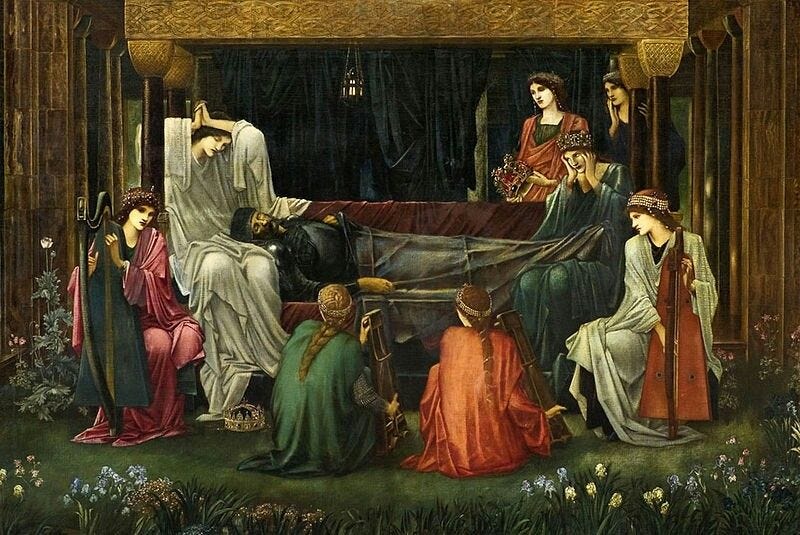
How long has Avalon, Insula Pomorum, the Island of Apples inhabited the metaphysics of my imagination? I cannot say. It’s as though it accompanied me when I came to the world from the Before Time.
I recall a dream—or is it a reverie?—in which I was a warrior at the dawn of the age in a land rich in trees and streams. I had fallen in battle and was left for dead. After the armies departed and consigned the dead to the crows, a group of women—were they nuns?—found me, lifted my wounded body from the blood-stained earth and laid me on a cart. With each jolt of the wheels, blood coughed from my wounds. That is all I remember.
I can’t say whether this dream came to me before or after I had heard of Arthur and his departure for Avalon to the care of women “to be healed of his grievous wounds.” Either the story of Arthur informed the images or the dream itself tapped into the Otherworld, a realm of poetic metaphysics where time is plastic and biography and imagination coalesce. I don’t think the order matters all that much.
The dream and Arthur’s departure to Avalon speak of both violence and care, of world-weariness and restoration, of the masculine and the feminine, of hell and heaven. The coughing wound—is it not a masculine image of feminine ontology? So who better to treat such a wound?
But the healing of the wound is companioned by the promise of a man again made whole, returned to the masculine, returned to the world. Rex quondam, rexque futurus.
So much has the imagination of this island at the edge of the Real been ingrained in my soul that I named my first business Avalon, an organic gardening and landscaping venture. And one of the first duties I have taken at each of the houses I have owned has been to plant a small orchard of apple trees. For what is more miraculous than an orchard, whether in spring when the trees are full in blossom and heavy in scent and the humming of bees or in the autumn harvest?
A melancholy, however, also inheres the imaginal landscape of Avalon, as the wounded king is required to abandon the world to chaos and forlornness. Geoffrey of Monmouth laments of Guinevere that “she gave way to despair,” a feeling with which we are all familiar. As Yeats so accurately writes in “The Stolen Child,” another imaginal departure for an Otherworld, “For the world’s more full of weeping than you can understand.”
It seems to me that the threshold to this Otherworld always appears in the guise of the feminine, for all thresholds are echoes of the metaxu, the between, which is under the aegis of Sophia. The threshold is the vesica piscis of two intersecting worlds or domains of being. It is likewise a passageway of birth into a new world. Therefore, the threshold is likewise a wound between worlds. And who better to treat such a wound?
On X the other day a teacher said kids don't know who King Arthur is any more. That polyvalent wound image is such a fine symbol. I think of Clarissa Estes quoting Apollinaire, "the violet light at the edge of the wound." And there is something so liminal and flourishing and fertile about apple orchards, the ee cummings paradox of tulips and chimneys, order and wild blossoms. I used to want to be married in an apple orchard wearing blue silk, the aisle between the trees.
My failed San Francisco housecleaning business was called Hylozoist Housecleaning, with ads that said "your matter matters to us," but despite the place being saturated with hippie physicists, I had to get customers in more ordinary ways. All long ago. Your books and Magic and Melancholia came, though, to follow The Gammage Cup and Julia Kristeva's Teresa of Avila book.
If the aliens really are arriving, theologians such as yourself need to be called up, not a bunch of televangelist types. It will be War of the Worlds with a side of hantavirus. Arthur and Christ need to return.
At the end there, you're practically describing the vision Philip K Dick had...